
Circularity · in a Hub
Circular economy in its original sense. Waste → wealth. Every byproduct becomes someone else’s input.
The Circularity Network™
Both products share the same backbone — land, communities, local entrepreneurs, biproduct offtakers, carbon credits, CSR, investors and MACCIA’s OVOE alignment. Granullo handles programmable money movement across everything. Only what we call “Circularity” — and which tech layer plugs in — differs.
Circularity · in a Hub
Circular economy in its original sense. Waste → wealth. Every byproduct becomes someone else’s input.
Circularity · in a Station
A shared-resource capital cycle of the kind the world’s largest infrastructure players already operate amongst themselves — land, power, compute and capital pooled into one closed flow of shared ownership and shared revenue. Brought to rural communities.
 Network · Parent
The orchestration layer. Pre-aligned communities, partners, capital and intelligence — wired into a single deployment system.
Child A · Digital Infrastructure
Connects DeCharge micro data centres and EV charging with land, biproduct offtakers, carbon credits, CSR, investors and communities — for shared ownership, jobs and a local entrepreneur, aligned with MACCIA's OVOE program.
Components
Revenue sources
Child B · Resource Infrastructure
Connects waste sources, logistics partners and recycling tech with land, biproduct offtakers, carbon credits, CSR, investors and communities — for shared ownership, jobs and a local entrepreneur, aligned with MACCIA's OVOE program.
Components
Revenue sources
Different tech. Same network backbone. Granullo handles programmable money movement across both.
Both nodes share the same backbone. Tap a tab to flip the full deep-read — twin, narrative, simulator, moat, Q&A — between Station and Hub. A floating dock will follow you as you scroll.
A node in the Circularity Network™ · Digital Infrastructure
A repeatable deployment model that transforms underutilised land into revenue-generating energy and compute infrastructure.
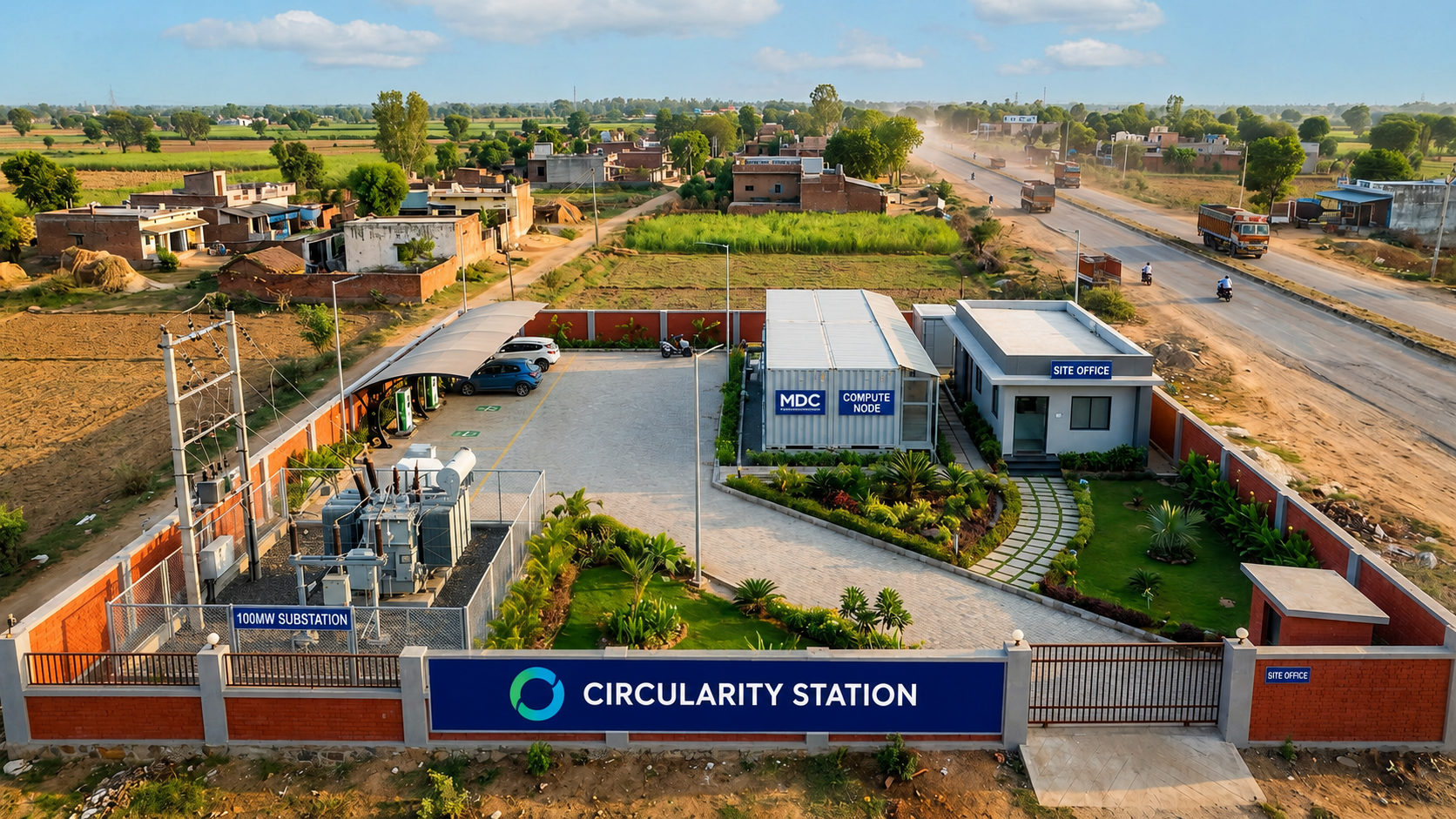 Orchestrated by Circularity
Hover or tap each hotspot to identify the seven components of a Circularity Station. · The image is the explanation.
The Circularity Infrastructure Stack
Both products share the same backbone — land, communities, local entrepreneurs, biproduct offtakers, carbon credits, CSR, investors and MACCIA’s OVOE alignment. Granullo handles programmable money movement across everything. Only what “Circularity” means — and which tech plugs in — differs.
In a Hub: circular economy in its original sense — waste → wealth.
In a Station: a shared-resource capital cycle of the kind the world’s largest infrastructure players already operate amongst themselves — land, power, compute and capital pooled into one closed flow of shared ownership and shared revenue. Brought to rural communities.
This page
Purpose
Energy + Digital Infrastructure
Components
Revenue Sources
Parallel product
Purpose
Circular Economy Infrastructure
Components
Revenue Sources
Stations create digital revenue. Hubs create circular revenue. Granullo moves the money. Together they create village economies.
Stakeholders · clear ownership
Every party has an explicit role, an explicit benefit, and an explicit incentive. No hidden dependencies.
Network architect & orchestrator.
Technology partner — deploys & operates the physical stack.
The village. The participants. The point.
Local franchise operator — the unit of replication.
Deployment fuel — CSR, blended, debt, equity.
Policy enabler · co-investor · offtake.
What one station produces
4–10
Guntha
Land per station
100 kW
Power
Substation-anchored
2
EV Chargers
Fast charging deployed
Edge MDC
Compute Node
AI + connectivity
2–10+
Jobs
Direct and indirect
₹17.22L
Annual net
Indicative per station
₹53.2L
CAPEX
All-in per station
~3.1 yrs
Payback
Indicative · model v1
Indicative · per-station model v1 · partner-dependent · subject to site-level validation.
Illustrative economics based on current deployment assumptions and partner-provided operating models. Actual performance may vary by geography, utilisation, pricing, power availability and commercial agreements. Nothing on this page constitutes financial advice, investment advice or a guarantee of future performance.
Circularity Station Economics Simulator™
Every output below is derived from the Circularity Station Model v1 (per-station CAPEX ₹53.2 Lakh · monthly revenue ₹4.67 Lakh · monthly net ₹1.435 Lakh). All values illustrative.
Rates updated: Oct 11, 2026
Projected outcomes · illustrative · ₹INR
Stations
250
Capital required
₹133.00 Cr
Monthly revenue
₹11.68 Cr
Annual revenue
₹140.10 Cr
Cumulative revenue
₹700.50 Cr
Monthly net profit
₹3.59 Cr
Annual net profit
₹43.05 Cr
Cumulative net profit
₹215.25 Cr
Circularity revenue
₹21.53 Cr
Community income
₹22.60 Cr
Jobs created
1,275
Entrepreneurs
300
Operators
250
AI compute capacity
30,000 rack-yr
Indicative payback
~3.1 yr
These results are illustrative simulations, not financial projections or guarantees. Actual outcomes depend on location, partners, demand, policy and execution.
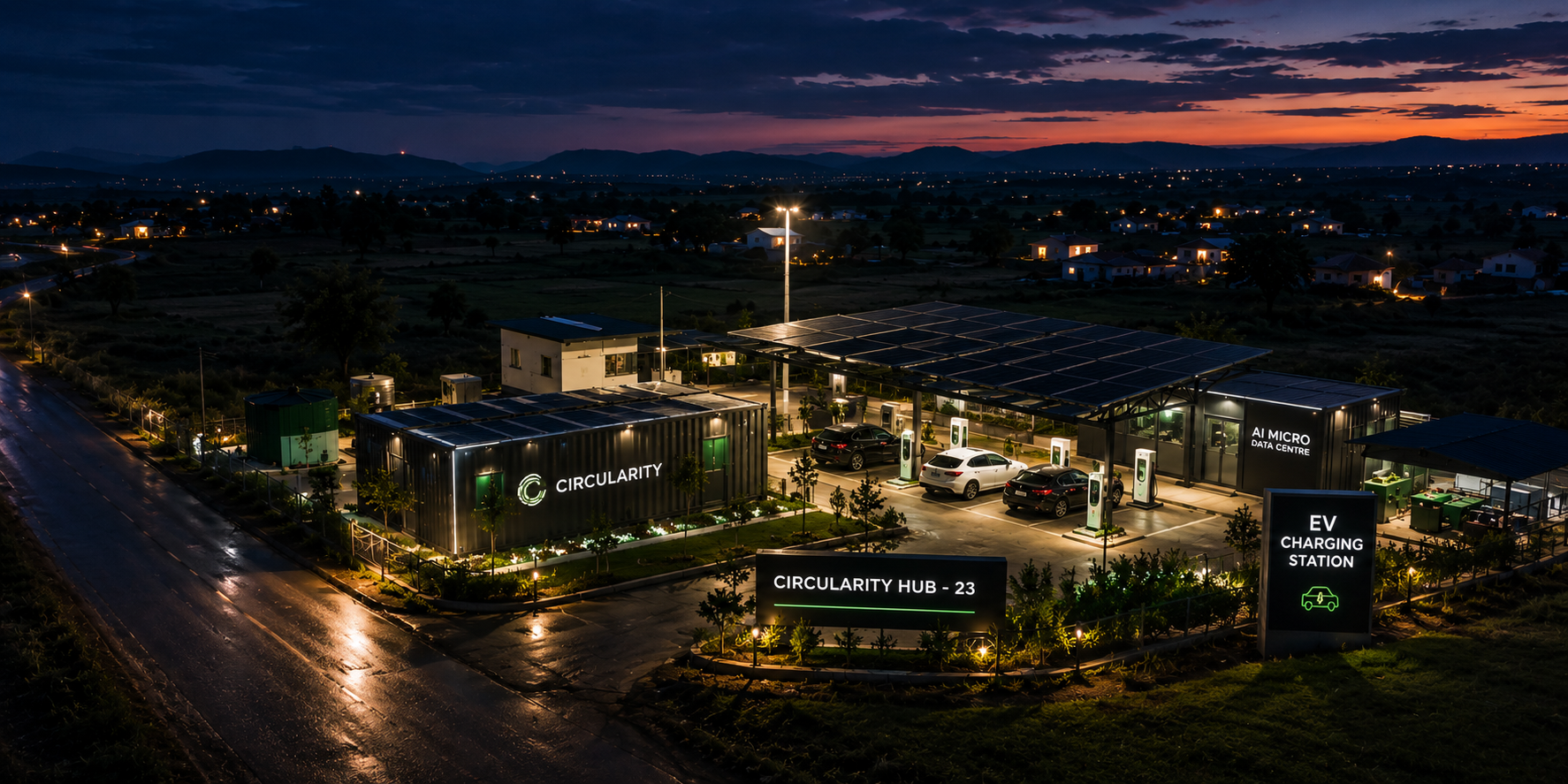
Future Deployment Vision
The Moat
Not technology. Not patents. Not software. The moat is the set of compounding deployment assets that competitors cannot buy with capital alone.
Multi-party orchestration with DeCharge, district government, financiers and community — pre-aligned per corridor.
Direct relationships with the communities each station serves. Trust takes years; capital can't shortcut it.
Active MoUs, district coordination, FAME-III alignment — the regulatory rails are already wired.
Substation-anchored sites along active highway corridors — sites get scarcer with every deployment.
A pre-aligned roster of technology, finance and operations partners that plugs into every new station.
Real performance data from real stations — feeds the matching graph and tightens unit economics.
The blueprint, training curriculum and reporting stack that lets the next station ship faster than the last.
Each station strengthens every other station — corridor density, brand trust, capital recyclability.
Investor mode · ten questions
A sophisticated investor should answer all ten before scheduling a call.
How the model works
A single seven-step blueprint runs every Station and every Hub. Only the tech partner in step 02 differs.
Identify a community-aligned site with permits + the right partner mix.
Circularity
Pair the right tech partner — Station (EV/MDC) or Hub (recycling/biochar).
Circularity
Modular Station or Hub installed on-site by the tech partner.
Tech Partners
Local operators + entrepreneurs onboarded.
Circularity
Tech partners operate; local team handles daily presence.
Joint
Multi-stream revenue — charging/compute for Stations · materials/credits for Hubs.
Joint
Each node seeds the next match. Repeat across corridors, districts, regions.
Circularity
Why the network scales
Each rung is a checkpoint along the same blueprint. Same operating model, same partner stack, same training curriculum — replicated across districts, states and regions.
Each node compounds the next — density, brand trust, recyclable capital, denser community participation, sharper unit economics. The asset is replicated. The advantage is cumulative.
The Circularity Network Flywheel™
Every Station and every Hub deploys into the same eight-layer flywheel. Each layer makes the next one cheaper to deploy, faster to operate and harder to replicate.
Hover any layer · the wheel responds
Capital alone cannot buy the network. Land access, community trust, partner ecosystem, deployment data and the matching graph get more valuable with every Station and every Hub that deploys.
Pick a side. Both belong to the Network.